

Strong motion accelerographs have recorded earthquakes for decades, and the sensing task itself is largely solved. What actually separates a better strong motion accelerograph today is everything around the sensor: open data formats you control, timing that scales across an array from a single GNSS reference, modern digital MEMS sensing, an architecture matched to your application, and a system your own team can operate without the installer. This post explains the five decisions that decide whether the instrument you specify is still useful, and still yours, in five years.
If you're new to these instruments, start with our overview of what a strong motion accelerograph is.
In this article
- Strong motion is a different sensing problem to weak motion
- Why accelerographs are not commodity hardware
- 1. Open data as a design principle
- 2. Array timing that scales with the deployment
- 3. Digital MEMS versus force-balance sensing
- 4. Dynamic range and architecture matched to the application
- 5. Independence in delivery, not just in data
- Why this approach holds up under real conditions
- Frequently asked questions
Strong motion is a different sensing problem to weak motion
Seismic sensors broadly split into two categories, and it is worth being precise about which one strong motion work actually needs. Weak-motion seismometers, the broadband instruments used for regional and teleseismic earthquake detection, are built for extreme sensitivity, typically with a self-noise floor below 1 ng/√Hz, so they can pick up the faintest distant tremor. Strong-motion instruments are built for the opposite problem: recording the near-field shaking of a significant, potentially damaging earthquake without clipping, which means a self-noise floor up in the region of 1 µg/√Hz is normal and appropriate, three orders of magnitude higher than a broadband seismometer, because the priority is dynamic range and headroom, not detecting the smallest possible signal. This is the same distinction that separates a general-purpose seismograph from a purpose-built accelerograph.
The other constant across both categories is bandwidth. Earthquake signals of engineering interest generally fall between about 8 mHz and 50 Hz, so any strong motion instrument, and any timing and digitising system built around it, has to perform cleanly across that full range, not just at a single frequency.
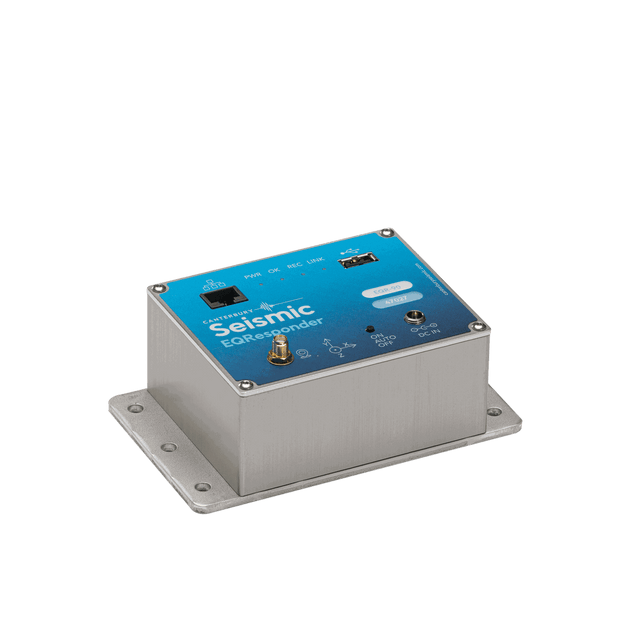
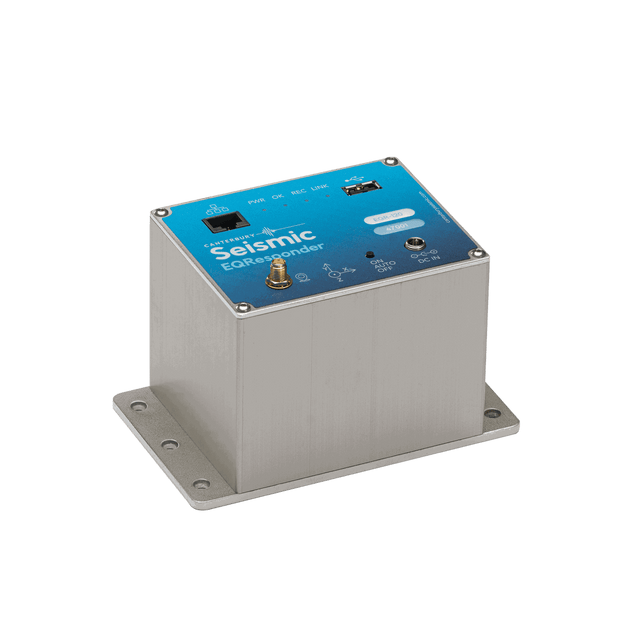
The EQResponder family of strong motion accelerographs.
Why accelerographs are not commodity hardware
It is tempting to compare strong motion recorders on spec sheet numbers alone: dynamic range, sample rate, channel count. Those numbers matter, but they do not tell you whether the instrument will still be useful to your project five years from now, or whether your own engineering team can operate it without calling the installer every time they need data out. Five things separate a genuinely better approach from a spec-sheet match.
1. Open data as a design principle, not a feature
Many strong motion systems lock recorded data inside a proprietary software layer. You can view it, sometimes export a limited subset, but getting continuous, unrestricted access to your own recordings requires the vendor's licensed tools.
The alternative is building the instrument to output standard, non-proprietary formats from the start: MiniSEED for waveform data, CSV and JSON for structured output, and SeedLink for real-time streaming. This is not a compliance checkbox. It means your data pipeline, whatever analysis software your team already uses, whatever your consulting engineers standardise on, works without a licensing gate in the middle of it.
For research institutions and government seismic networks in particular, this matters operationally. Data has to move into existing regional and international networks like GeoNet and IRIS without a translation step, and it has to remain accessible even if the original vendor relationship ends.
2. Array timing that scales with the deployment, not against it
Structural and array-based monitoring depends on precise time synchronisation across every node. The conventional approach requires a GPS antenna at every recording unit, which is a real cost and installation burden once you are deploying more than a handful of instruments, particularly on structures where antenna placement is constrained.
A better approach uses any-node PTP (Precision Time Protocol) timing, where a single GNSS reference can synchronise the whole array over standard network connections. One antenna, not one per node. This has been validated in field deployments against major competitor platforms, and it changes the economics of larger arrays meaningfully, without compromising the sub-millisecond synchronisation that structural analysis and array processing need.
3. Digital MEMS versus legacy force-balance sensing
The shift from analogue to digital sensing has been gradual rather than sudden. Digital accelerometers built on micro-electromechanical systems (MEMS) first reached the market roughly two decades ago, and continued development since then has closed, and in many respects reversed, the performance gap with older force-balance accelerometer sensors.
| Characteristic | Digital MEMS sensing | Force-balance (traditional) |
|---|---|---|
| Frequency response | Flat and linear across a wide bandwidth | Damped below natural frequency, distorted above it |
| Stability | Low sensitivity to temperature, age, tolerance | Can drift with temperature, age, and manufacturing tolerance |
| Axes | Three components in one unit, no orientation compensation | Horizontal components need orientation compensation |
| DC response | Responds to DC, enabling gravity calibration and static measurement | Typically no DC response |
| Size, power, cost | Smaller, lower power, cheaper at scale | Larger, higher power, costlier per point |
| Best for | Most strong motion and structural monitoring | Niche ultra-high-sensitivity and specialised blast monitoring |
The difference shows up in a few places that matter for strong motion work. Digital sensors can hold a flat, linear response across a much wider bandwidth, with far less sensitivity to environmental and manufacturing variables, which means what gets recorded is a more faithful representation of the actual motion, in both amplitude and phase. Noise floor performance has also improved substantially, which matters for picking up small or distant signals without sacrificing the dynamic range needed to capture a major event without clipping. And because a single three-component digital sensor captures all three axes in one compact unit, coupling to the structure or ground is simpler and more consistent across a deployment.
Because digital MEMS sensors respond all the way down to DC, they can also measure static acceleration, which is what makes factory calibration against a known reference like gravity possible, rather than relying purely on manufacturing tolerance. That same DC response is why tilt needs careful handling: because of the equivalence principle, an accelerometer alone cannot distinguish a genuine change in structural tilt from an ordinary horizontal acceleration, since both look the same to the sensor. Picking up real, permanent tilt or residual deformation after an event reliably means pairing the accelerometer with a dedicated tilt reference or angular sensor, not reading it off a single channel in isolation.
There are operational and cost benefits too. Smaller, lower-power digital sensors are easier to transport, install, and maintain at scale than strings of traditional analogue accelerometers. Manufacturing MEMS sensors at scale is also considerably cheaper, which is part of why dense, many-sensor deployments across a single structure or an entire portfolio of buildings have become practical in a way they were not a decade ago. None of this makes traditional sensors obsolete outright: in a narrow set of extremely high-sensitivity or specialised blast-monitoring applications they can still have an edge. But for the great majority of strong motion and structural monitoring applications, digital MEMS sensing offers the better overall balance of performance, durability, cost, and form factor.
4. Dynamic range and architecture matched to the application
Strong motion recording spans an unusually wide range: from ambient background vibration through to the near-field acceleration of a major event, without clipping. High dynamic range digitisers in the 130+ dB class sit at the upper end of what is achievable in current strong-motion accelerograph technology, and that headroom is what keeps an instrument useful across the full range of events it will actually see over its service life, not just the design event.
Just as important is architecture flexibility. Free-field monitoring is a single-sensor problem. Structural and array monitoring is a multi-channel, often multi-sensor-type problem, sometimes mixing accelerometers and other structural sensors into one central recording and timing point. Instruments designed around a single-sensor use case get retrofitted for this. Instruments designed for it handle heterogeneous sensor inputs and central synchronisation natively.
5. Independence in delivery, not just in data
The last piece is less about the sensor and more about how the system is deployed and supported. A system that requires the original installer to be involved every time data needs extracting, a configuration needs changing, or a new sensor needs adding creates an ongoing dependency that outlasts the original project. An independently operable system, backed by an open data architecture, means your own technical team retains control of the asset for its full service life.
Right-sized strong motion accelerographs and array recording, with open data and array-scale timing built in. From a single instrument to a full structural array.
See the instruments →Why this approach holds up under real conditions
None of this is theoretical. Canterbury Seismic Instruments was one of the first to bring MEMS-based digital strong motion recorders to market, with close to two decades of experience working with the technology, and the EQResponder family is now in its second generation, refined directly off two decades of field deployment rather than designed once and left alone. Instrumentation built on these principles operated through the Canterbury 2011 earthquake sequence, one of the most intensively recorded strong motion sequences globally, and has continued to be deployed and refined against that operational experience ever since. That combination, research-grade design validated against real, high-intensity events, is a different starting point to instrumentation designed primarily against a spec sheet.
For engineers and institutions specifying strong motion instrumentation today, the practical question is not just "does it record accurately." It is "will my team still have full, unrestricted access to and control over this system and its data in five years." Open formats, array-scale timing, modern digital sensing, application-matched architecture, and independent operability are the things that answer that question well.
Frequently asked questions
What is the difference between a seismograph and an accelerograph?
A seismograph is a general term for any instrument that records ground motion during an earthquake. It typically uses a seismometer, a highly sensitive sensor built to detect even faint tremors from hundreds of kilometres away. An accelerograph is a specific type of seismograph built around an accelerometer instead, a sensor with a much wider range but lower sensitivity, designed to record strong shaking without clipping. Seismometers are best suited to detecting small or distant events. Accelerometers are best suited to capturing potentially damaging shaking close to the source, which is why strong motion and structural monitoring almost always use accelerographs.
What is a strong motion accelerograph?
A strong motion accelerograph is an instrument that records the strong ground or structural acceleration produced by a significant, potentially damaging earthquake, without clipping. Unlike a sensitive broadband seismometer built to detect faint distant tremors, it prioritises dynamic range and headroom so it can faithfully capture near-field shaking during a major event.
What is the difference between strong motion and weak motion seismic sensors?
Weak-motion (broadband) seismometers are built for extreme sensitivity, with a self-noise floor below about 1 ng/√Hz, to detect the smallest distant signals. Strong-motion instruments are built for the opposite: a self-noise floor around 1 µg/√Hz is normal and appropriate, because the goal is to record large near-field shaking without clipping, not to detect the faintest possible tremor.
Are MEMS accelerometers as good as force-balance accelerometers?
For the great majority of strong motion and structural monitoring, yes. Modern digital MEMS sensors have closed, and in many respects reversed, the gap with force-balance accelerometers: flatter and more linear response, less drift with temperature and age, three axes in one unit, and lower size, power and cost. Force-balance sensors retain an edge only in a narrow set of ultra-high-sensitivity or specialised blast-monitoring applications.
Do I need a GPS antenna at every accelerograph?
No. With any-node PTP (Precision Time Protocol) timing, a single GNSS reference can synchronise an entire array over standard network connections, holding sub-millisecond synchronisation. That removes the cost and installation burden of a GPS antenna at every node, which matters most on structures where antenna placement is constrained.
What data formats should a strong motion recorder output?
Open, non-proprietary standards: MiniSEED for waveform data, CSV and JSON for structured output, and SeedLink for real-time streaming. Open formats let your recordings flow into whatever analysis tools your team uses and into networks like GeoNet and IRIS without a translation step or a licensing gate, and they keep the data accessible even if the vendor relationship ends.
Canterbury Seismic Instruments designs and manufactures strong motion accelerographs and structural array recording systems from Christchurch, New Zealand.


